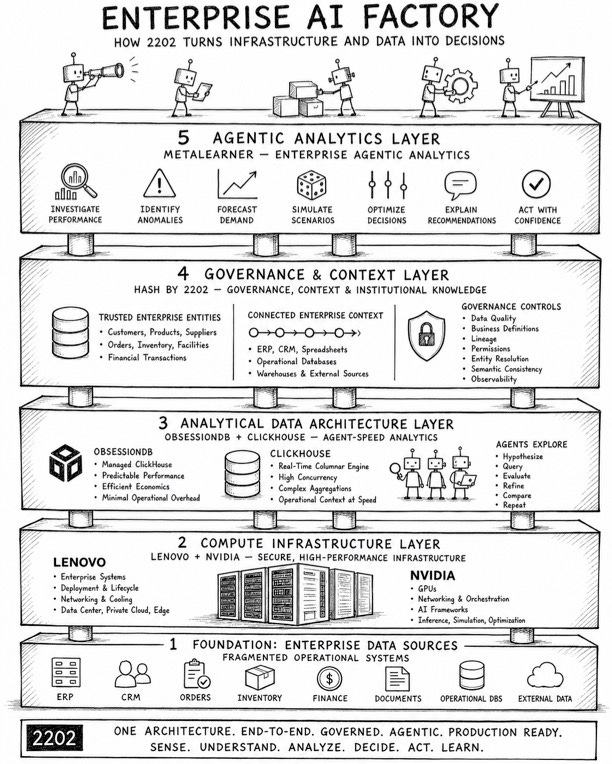
How 2202 turns infrastructure, data, governance, and optimization into decisions.

Most companies want the outcome of AI without building the factory that produces it. They want better forecasts, faster analysis, autonomous agents, lower costs, higher service levels, and better decisions. But many start in the wrong place.
They start with the model.
The model is not the factory. The model is one machine inside the factory.
For enterprise AI to work in production, the harder question is not simply “which model should we use?” The harder question is whether the enterprise has built the architecture required for that model to access the right data, understand what the data means, respect governance rules, reason over current operating conditions, simulate alternatives, optimize against constraints, explain its recommendation, and turn the result into an action the business can trust.
Most enterprise AI breaks somewhere between data and decision.
The data exists, but it is fragmented. The systems exist, but they do not agree. The dashboards exist, but the decision still happens in Excel. The model can answer, but it does not always know whether the answer is trusted, current, governed, or operationally safe.
That is why 2202 is building the Enterprise AI Factory.
The point of an Enterprise AI Factory is not to run more models. It is to produce better decisions at lower cost, with stronger governance, repeatable economics, and a path from analysis to action.
The fruit of enterprise AI is better decisions. The roots are data architecture, compute, governance, context, and optimization. Too many companies are trying to harvest the fruit before building the roots.
Why model-first AI breaks in the enterprise
A consumer AI product can often start with the model. An enterprise AI system usually cannot.
Enterprises are messy by design. They run on ERP systems, CRMs, operational databases, data warehouses, documents, spreadsheets, external feeds, custom workflows, and institutional knowledge accumulated over many years. Definitions differ between departments. Records are duplicated. Business rules are buried in code. Important context lives in the heads of experienced employees. Planning still moves through Excel because teams need flexibility that systems of record were never designed to provide.
A model sitting on top of that environment may be powerful, but it is not automatically useful.
It may retrieve a field without knowing whether that field is authoritative. It may summarize a report without understanding the business definition behind the metric. It may generate an answer without knowing whether the user is authorized to act on it. It may recommend an action without understanding operational constraints, service-level commitments, working-capital limits, or downstream risk.
This is why many enterprise AI initiatives remain trapped as pilots. They look impressive in controlled demos, but they fail to become reusable operating systems for the business.
The issue is not that AI is overhyped. The issue is that production AI requires more than a model.
It requires a factory.
What an Enterprise AI Factory must produce
A factory is not valuable because machines exist inside it. A factory is valuable because it produces something repeatably.
The Enterprise AI Factory must produce trusted decisions.
That means it must connect fragmented enterprise data, process it efficiently, make it queryable at agent speed, govern it through a business ontology, transform it into forecasts and scenarios, optimize against real constraints, explain the recommendation, and support controlled action.
This is the difference between an AI demo and an enterprise decision system.
A demo answers a question. A decision system changes how the business operates.
A demo can live on a narrow dataset. A decision system must work across messy enterprise reality.
A demo can tolerate ambiguity. A decision system needs lineage, permissions, definitions, reconciliation, and accountability.
At 2202, we think the Enterprise AI Factory requires five foundational layers:
1. Enterprise data sources
2. Compute infrastructure
3. Analytical data architecture
4. Governance and context
5. Agentic analytics and decision intelligence
Each layer solves a different failure mode. Together, they turn infrastructure and data into decisions.
Foundation: enterprise data sources
The first layer is the most obvious and the most underestimated.
Enterprises do not lack data. They have too much data spread across too many systems.
ERP contains orders, inventory, purchasing, production, finance, and controlling data. CRM contains customers, opportunities, accounts, sales activities, and service interactions. Operational databases hold transactions and events. Warehouses and lakes store transformed data. Documents contain policies, contracts, reports, and procedures. Spreadsheets contain planning assumptions, manual adjustments, and business logic that never made it into the system.
This is where the AI-ready data problem begins.
AI-ready data is not just clean data. It is data that has been unified, reconciled, refreshed, governed, and organized around the business entities that matter: customers, products, suppliers, orders, inventory, facilities, assets, contracts, invoices, and financial transactions.
Without that foundation, AI does not eliminate complexity. It automates the inconsistencies already embedded in the organization.
This is why the first job of the Enterprise AI Factory is not to generate an answer. It is to make enterprise data usable for intelligence.
Compute infrastructure: the physical factory
Once enterprise data is connected, the next challenge is computation.
Enterprise AI workloads are not always light. Forecasting across thousands of SKUs, testing large feature sets, simulating scenarios, running optimization, evaluating models, and supporting concurrent agents can become computationally demanding very quickly.
This is where Lenovo and NVIDIA matter.
Lenovo provides the enterprise-grade systems, deployment capability, lifecycle services, and infrastructure footprint needed to operate production AI across data centers, private clouds, edge environments, and governed enterprise networks. NVIDIA provides the accelerated computing platform that makes high-throughput inference, simulation, forecasting, optimization, and agent workloads economically possible.
But compute alone does not create intelligence.
This is where many enterprise AI strategies get the order wrong. Infrastructure without a decision workload is cost. Infrastructure attached to better operating decisions becomes ROI.
The question is not simply cloud versus on-premises. The strategic question is where each workload should run to achieve the best balance of performance, economics, security, latency, and operational control.
Cloud platforms offer flexibility and rapid deployment. Private and hybrid deployments can improve control, reduce latency, keep sensitive data closer to the business, and lower the unit cost of continuous data-intensive computation.
The right architecture is not ideological. It is fit for purpose.
A real AI factory places each workload where it creates the best operating outcome.
Analytical data architecture: agent-speed exploration
Enterprise AI agents do not behave like dashboards.
A dashboard usually asks a known question against a prepared dataset. Agents investigate. They form hypotheses, query data, evaluate results, refine the question, compare scenarios, and repeat the process. They may do this across billions of records, with many agents operating concurrently, and with users expecting answers quickly.
That requires an analytical data architecture built for speed, scale, and exploration.
ClickHouse provides the real-time, column-oriented analytical engine. It allows agents to execute complex aggregations, calculate features, reconstruct historical states, and retrieve current operational context with the responsiveness required for interactive and autonomous workflows.
ObsessionDB makes that analytical engine operable.
ClickHouse gives agents analytical speed. ObsessionDB makes that speed production-ready: managed ClickHouse, predictable performance, efficient economics, and lower operational overhead for teams that do not want to build a specialist database organization around scaling, replication, schema optimization, caching, and database observability.
This layer matters because agents are only useful if they can reason over current conditions. Static extracts prepared days earlier are not enough. Agentic systems need to query, compare, refine, and recompute at the speed of the business.
This is also where cost matters.
Agentic analytics can generate far more queries than traditional business intelligence. A human analyst may ask five questions. An agent may ask fifty before producing a recommendation. Multiply that across functions, teams, and workflows, and analytical economics become part of the AI strategy.
The Enterprise AI Factory needs data architecture that is fast enough for agents, efficient enough for production, and reliable enough for enterprise operations.
Governance and context: Hash as the enterprise blueprint
Fast access to data is still not enough.
An agent can retrieve information in milliseconds and still produce the wrong answer if the underlying records are duplicated, inconsistently defined, disconnected from their business meaning, or accessible to the wrong user.
This is why governance and context are not compliance afterthoughts. They are the intelligence layer.
Hash provides this layer for 2202.
Hash connects information across ERP systems, CRMs, spreadsheets, operational databases, data warehouses, documents, and external sources. It reconciles fragmented records into trusted enterprise entities and creates a coherent representation of the organization’s customers, products, suppliers, transactions, facilities, policies, and operational relationships.
This is not just a semantic layer in the narrow dashboard sense. It is a governed representation of how the enterprise works.
Hash provides the controls required for production AI: data quality and observability, business definitions, semantic consistency, lineage, historical traceability, permissions, governance policies, entity resolution, and relationship mapping.
This is the difference between giving an agent access to data and giving it access to institutional knowledge.
Without Hash, an agent is querying tables. With Hash, an agent understands business entities, relationships, permissions, definitions, and context.
That distinction matters.
A supply chain agent should not need to guess whether “available inventory” includes goods in transit, reserved stock, blocked stock, quality holds, or customer commitments. A finance agent should not invent a margin definition. A procurement agent should not recommend an action without understanding supplier constraints, approval rules, and policy boundaries.
Hash is the enterprise blueprint. It tells AI what the business means.
Agentic analytics: MetaLearner turns context into decisions
Once the compute, analytical data, and governance layers are in place, MetaLearner converts that foundation into operational intelligence.
This is where the factory produces the output.
The output is not a chatbot. It is a governed decision workflow.
MetaLearner combines enterprise context with forecasting, scenario simulation, feature selection, robust optimization, explainability, and controlled action. It is designed for business problems where the answer is not simply “retrieve this document” or “summarize this report,” but “what should we do next?”
Forecasting is a good example.
Many enterprises treat forecasting as if one model can be applied everywhere. That is rarely true. Different products, customers, facilities, markets, and time series behave differently. Some are seasonal. Some are intermittent. Some are promotion-driven. Some are sensitive to macroeconomic variables. Some have sparse history. Some are shaped by customer commitments or supply constraints.
The same is true for features.
Modern enterprises can generate thousands of possible features from macroeconomic, financial, commercial, operational, and external data. But more features do not automatically produce better forecasts. Many are redundant, noisy, unstable, or expensive to compute. They can reduce model quality while increasing computational cost.
NVIDIA GPU computing allows us to generate, evaluate, and filter large feature sets efficiently. MetaLearner then uses the characteristics of each time series to determine which features, models, and model combinations are most appropriate for each forecasting problem.
That is why we call it MetaLearner.
It does not simply forecast. It learns which analytical methods work best under different business and statistical conditions.
But forecasting is only the start.
A forecast does not tell a supply chain team how much to buy, where to place inventory, which customer to protect, how much buffer to hold, or what to do when demand, lead times, capacity, or commitments change.
Those are decision problems.
MetaLearner agents can investigate business performance, identify anomalies and emerging risks, forecast demand and operational outcomes, simulate alternative future conditions, optimize inventory and resource allocation, explain recommendations in business language, and translate analysis into controlled operational action.
A supply chain executive should not need to write SQL, build a forecasting pipeline, configure an optimization solver, or understand CUDA to answer a critical business question.
They should be able to ask: Why are service levels declining? Which products are likely to stock out? How much inventory is required to achieve our target service level? What happens if demand rises by 15%? Which replenishment strategy performs best under uncertainty?
MetaLearner converts those questions into coordinated analytical workflows using governed enterprise data, real-time querying, GPU-accelerated computation, feature-based forecasting, scenario simulation, and robust optimization.
This is what separates enterprise agentic analytics from a chatbot.
The chatbot gives an answer. The decision system runs the business logic required to make that answer useful.
Why the layers must work together
The mistake is treating each layer as optional.
Without unified enterprise data, the model sees fragments. Without compute, the system cannot scale forecasting, simulation, optimization, and agent workloads economically. Without analytical architecture, agents cannot explore current data fast enough. Without governance and context, agents cannot understand what the data means or what they are allowed to do. Without MetaLearner, the stack may analyze the business but fail to improve the decision.
Each layer solves a different bottleneck.
Lenovo and NVIDIA provide the computational capacity. ObsessionDB and ClickHouse make enterprise data available at agent speed. Hash ensures that the data is trusted, governed, and understood. MetaLearner transforms that context into analysis, forecasts, simulations, optimized decisions, explanations, and actions.
That is why the Enterprise AI Factory is not another point solution. It is an architecture for repeatability.
Every enterprise should not have to rebuild the data, compute, analytics, governance, forecasting, and optimization stack for each AI use case. That is exactly why pilots fail to scale. Each one becomes a custom project.
A factory changes the economics. It turns one-off pilots into reusable capability.
The business value
The value of the Enterprise AI Factory is not “more AI.” The value is better operating decisions.
For executives, this shows up in practical terms: faster reconciliation, cleaner business context, lower analytical infrastructure overhead, better forecasting, stronger scenario planning, optimized inventory decisions, improved service levels, lower working capital, fewer manual planning cycles, and more reliable automation.
For CIOs, it creates an architecture that can be governed, deployed, scaled, and controlled. For COOs and supply chain leaders, it turns uncertainty into decision-ready actions. For CFOs, it connects AI to margin, cash conversion, and capital allocation. For planners and operators, it reduces the manual work required to move from data to decision.
This is the real promise of enterprise AI. Not a model that talks about the business.
A system that helps run the business.
2202 brings the factory together
2202 integrates these layers into a secure enterprise AI architecture that can be deployed where the customer requires it: inside its cloud, private infrastructure, data center, edge environment, or governed operational network.
The next generation of enterprise value will not come from placing a language model on top of an existing database.
It will come from connecting infrastructure, data, governance, analytical reasoning, and operational execution into one continuous system:
Sense. Understand. Analyze. Forecast. Simulate. Optimize. Explain. Decide. Act. Learn.
That is the architecture required for enterprise agentic AI.
Everyone wants AI outcomes. Better forecasts. Faster planning. Lower cost. Higher service levels. Better decisions.
But outcomes require a factory. That is what 2202 is building.
Great article Nico. There is no world where the older slow, expensive OLAP technologies can meet the agentic speed needed nowadays.